Insights / Product
MVP Blueprint vs PRD: What Founders Need Before Development
A 40-page spec is the wrong first document. Most early teams need a short blueprint: what you are building, for whom, what is out, and in what order.
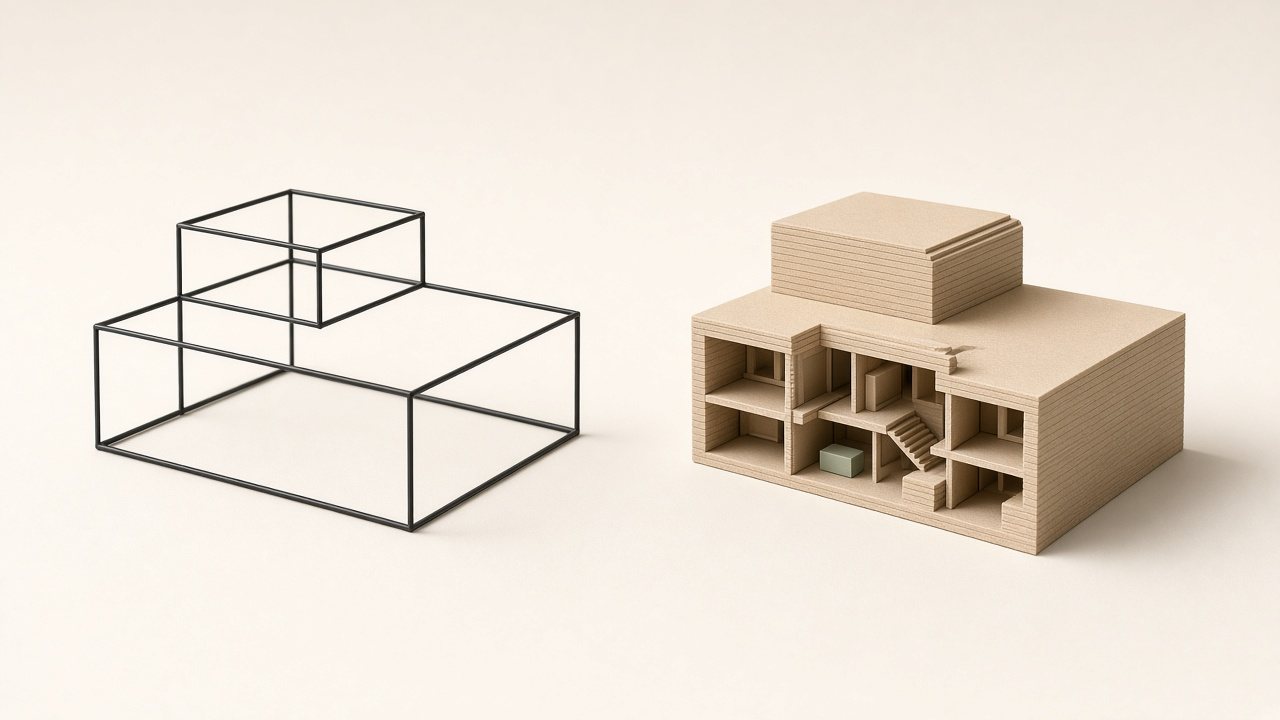
The difference in MVP blueprint vs PRD is simple: a blueprint decides what to build and test; a PRD specifies how a decided slice should behave. It is a sequence, not a rivalry. An MVP (minimum viable product) is the smallest product that tests a business assumption. A PRD (product requirements document) is a detailed spec for a team that has already decided what to build. Most founders have not. They have a pile of features and fear. A 40-page spec at that moment is how you freeze a guess in formal language. The first document should be short: the test, the user, what is in, what is out, and the order of work.
“MVP blueprint” is not a formal industry term. Here it means a short scoping document; teams also call it a one-pager, a lean spec, or a scope document. MVP Blueprint is also the name of a package on this site, covered at the end — everything before that applies to any short scope document. If a vendor will not talk to you without a long spec, they may be a good factory for a later phase. They are a poor partner for an MVP.
This article tells you what belongs in the short document, what belongs in a later PRD, and how to produce a one-pager this week even if you never book a session.
MVP blueprint vs PRD: different jobs
A blueprint answers: What are we testing? Who is it for? What must ship? What is forbidden in version one? What is the first slice a builder can estimate? What could kill the plan?
A PRD answers: For the slice we already chose, what are the screens, states, empty cases, permissions, analytics events, and acceptance criteria? It is a contract between product and engineering (and often a vendor).
If you write the PRD first, you will specify referrals, settings, and edge cases for a workflow that might not be the workflow. You will pay to change the spec when the first users tell you the truth. Specs are expensive to rewrite because they feel official. Official and true are not the same.
If you never write any document, you will pay in Slack. The builder will invent a product. You will say “that’s not what I meant” in week six. A handful of pages is cheaper than that surprise.
Related cuts: what should be in an MVP and MVP development cost. If you need ongoing decision cadence rather than a document, that is a different role — see fractional CTO (a part-time senior technical leader on a retainer).
| What to compare | MVP blueprint | PRD (product requirements document) |
|---|---|---|
| Question it answers | What should we build, for whom, and what will we test? | How exactly should the chosen slice behave? |
| Length | A handful of pages | Often long; grows with team size |
| When | Before quotes and the first build | When the slice is chosen and must be built unambiguously |
| Contains | Test, users, in/out, sequence, risks | States, rules, acceptance, edge cases |
| Does not contain | Every screen and every error message | A new product vision every chapter |
| Changes when | The test or the cut changes | The agreed slice’s behaviour changes |
| Owner | Founder (with an advisor if needed) | Product plus engineering |
Why a 40-page spec is the wrong first document
Length signals completeness. Completeness is fake when the buyer is still a hypothesis. Forty pages of invented edge cases will impress a procurement-minded vendor. They will not make the first user succeed.
PRDs assume you already know the user, the job, the platform, and the non-goals. Early teams use the PRD to postpone those arguments. The arguments show up in sprint four anyway, when changing direction is costlier.
A long spec also invites extra build. Engineers implement what is written. If you wrote a huge settings section, you will get one. The document trained the team to treat your anxiety as scope.
There are times a long spec is correct: regulated workflows, a large vendor contract, a team of many squads, a version two of a product that already has users. Those are not the typical pre-MVP founder. Do not borrow enterprise process to calm pre-product fear.
If your co-founder wants forty pages because they do not trust the builder, the trust problem is real. A short blueprint plus a paid spike plus weekly review is a better fix than a long spec nobody will maintain.
What belongs in a short blueprint
- Objective in one sentence, including the test and a number if you have one.
- User: job, context, who pays. One primary user. Secondary users as a note, not as equal scope.
- Current workaround: what they do today. If you do not know, you are not ready — validate first.
- Must-have path: the steps the product has to support. Not a brainstorm. A path.
- Out of scope: a list that is allowed to be aggressive. This is the most valuable page.
- Priorities and phases: slice 1 / slice 2. Slice 1 must be shippable alone.
- Platform and constraints: web vs native, must-use vendors, must-avoid vendors.
- Risks: technical, market, key-person. What you will learn first.
- Open questions: honestly listed, not hidden inside fake requirements.
That is enough for a competent builder to produce a range. It is enough for you to reject a quote that assumed two apps and a custom CMS. It is not enough to implement every tooltip. It is not supposed to be.
What belongs in a later PRD
Once slice 1 is chosen, specify it. User stories or jobs for each step. States: empty, loading, error, success. Permissions if you have more than one role. Data you store. Integrations: happy path and what happens when the other system is down. Analytics: the few events that match the test. Acceptance criteria a QA-minded person could use.
Non-functional notes belong here when they are real: “must run in the customer’s browser without a desktop install,” not “world-class scale.” Fake scale requirements in a PRD become infrastructure spend.
UX detail belongs when you have a designer or when the builder needs it. Do not freeze mockups in a PRD before the path is stable. Pictures of the wrong workflow are still the wrong workflow.
A PRD should be versioned. When the product learns, the spec changes. A sacred PDF from month zero is a liability.
If you have no one to read a PRD — one freelancer who would rather have a call — keep the document shorter. Process should match the team. A 40-page spec for a two-person build is often a founder hiding from decisions.
When to write which — and who writes it
Write a blueprint when you are about to spend money on construction: quotes, a hire, an agency. Write a PRD when construction of a decided slice needs fewer verbal disagreements.
The founder owns the blueprint. An advisor can pressure-test it. A fractional CTO might own later architecture decisions; they should not be hired to produce a 40-page spec as the first artifact if the product is still uncut.
Engineering owns feasibility comments on both documents. They do not own the test. If engineering is inventing the customer, you have a product vacuum.
Agencies sometimes include “discovery” that outputs a large spec. Ask whether that spec is allowed to cut. If discovery cannot kill features, it is a preamble to a big SOW. You can still use them. Do not confuse their template with your MVP.
A builder should use the blueprint to estimate, to refuse out-of-scope work, and to propose a first slice that can ship alone. They should not use it as a treasure hunt for implied features. If they return a quote that includes a CMS, a notification platform, and a second app “because it was mentioned,” the document failed or they did not read the out-of-scope list. Ask them to quote the must-ship path only.
Revision discipline: change the blueprint when the test changes, not when someone has a new preference. Date the version. If you are on version nine before any user has seen a slice, you are using the document to avoid contact with the market. Stop revising. Talk to a buyer. Then cut again.
Do not paste the blueprint into a PRD tool and start adding tickets until slice 1 is agreed in writing. Tickets without a freeze are how a short plan becomes a forty-page spec by accident — one “quick story” at a time.
Neither, a blueprint, or a fuller PRD
Neither, yet, if nobody has confirmed the problem or the willingness to pay. Detailed specification of an untested idea is premature; validate the SaaS idea first. Neither also fits a tiny internal tool where the builder sits next to the user — a checklist and a weekly review may be enough.
A lightweight blueprint when the idea has some evidence and you are about to spend on construction: quotes, a first hire, an agency. It should be short enough to finish in days and sharp enough to reject a bad quote.
A fuller PRD when slice 1 is agreed and ambiguity is now the expensive part: several builders, a vendor contract, regulated workflows, or a version two with real users whose behaviour you must not break.
| Your situation | Write this now | Wait on this |
|---|---|---|
| Idea still untested | A validation plan, not a spec | Blueprint and PRD |
| Ready to get quotes | Blueprint | Full PRD |
| Slice 1 agreed, team of several | PRD for that slice | PRD for v3 features |
| Vendor needs a contract exhibit | PRD or SOW appendix for the bought slice | A vision manifesto |
A one-page plan you can write this week
You do not need my template to start. One page, today:
- The test in one numbered sentence.
- The user in five lines.
- The must-ship path in seven steps or fewer.
- Ten items that are out of scope. Force yourself to ten.
- The first slice that could ship alone.
- Three risks. One open question you will answer before a large invoice.
Read it out loud. If a builder still could not estimate, you were vague in the path — not short on pages. Add detail to the path, not a new chapter on brand colors.
Share that page with one person who was not in the room. If they cannot tell you who the user is and what is forbidden, the page is still unclear. Fix the nouns. Then, and only then, expand toward 4–6 pages: risks, phases, constraints. Expansion without a clear path is how you accidentally start a PRD.
If two founders produce two different one-pagers, you do not have a documentation problem. You have a company problem. Resolve the test before you hire a writer — or a developer — to paper over the split.
If you want that turned into a 4–6 page blueprint in a structured session, that is what this site’s MVP Blueprint package is for: $599 (featured) for 90 minutes plus a 4–6 page plan a developer can estimate from, built from up to three materials and a capped review. It is not unlimited revisions, not a full PRD, and not development, UI, or a ticket import; additional materials may be declined or quoted separately. If you should not be scoping yet, Idea Validation ($149, 45 minutes) is a diagnosis and a next test. Product Strategy ($299, 60 minutes plus an action summary) fits when the fight is priorities. Founder Advisory ($999/month, up to 20 hours, unused hours expire, independent contractor) or Private Founder Advisory (from $1,500/month; inquire) covers ongoing judgment. None of these include implementation or a full PRD unless contracted separately.
Book through the consultation page. Fees are non-refundable once paid, except if I cancel and we cannot agree a new date.
Decide on a few pages. Specify later. That is the whole distinction.
Questions people ask
Do I need a PRD for an MVP?
Usually not first. You need a short blueprint: what, for whom, what is out, in what order. A PRD assumes those decisions already exist.
What is an MVP blueprint?
“MVP blueprint” is not a formal industry term. Here it means a concise strategic document — typically a handful of pages — that a developer can estimate from. It is not a full software specification.
Can a consultant write my full PRD?
That is a different, larger engagement. Do not buy it until the MVP is cut. The $599 package is a 4–6 page blueprint, not unlimited pages.
When should I write a PRD?
Write a PRD when the product is decided enough that engineers need edge cases, states, and acceptance criteria — often after the first slice is real, or when a larger team needs a contract-quality spec.
Why do vendors ask for a 40-page PRD?
Factories like complete inputs. Early products do not have complete inputs. A vendor who will not talk without a long spec may be wrong for an MVP.
What belongs in a blueprint that does not belong in a PRD?
The test, the cut, the out-of-scope list, and the sequence. A PRD then specifies the must-ship slice in enough detail to build without reinventing the product.
Does the blueprint include wireframes and tickets?
No. It is a strategic cut and a phased plan. Design and backlog are later, or a separate contract.
How do I pay?
Book through the product consultation page. Fees are non-refundable once paid except if I cancel and we cannot agree a new date.